

Deligreencs
EU Stock-51.2V 628Ah LiFePO4 Battery DIY Kit - 33kWh Complete Pack with Cells | Smart BMS for Home Solar Storage-Pre-sale
EU Stock-51.2V 628Ah LiFePO4 Battery DIY Kit - 33kWh Complete Pack with Cells | Smart BMS for Home Solar Storage-Pre-sale
Nie można załadować gotowości do odbioru
Free Shipping | No tax | Door to Door
51.2V 628Ah LiFePO4 DIY Battery Kit – 32 kWh in a Single Pack
Build a high-capacity home solar storage battery with 16 pcs EVE MB56 628Ah prismatic LiFePO4 cells, a JK-PB2A16S-30P smart BMS with 2A active balancing and a ready-made steel cabinet with 4.3-inch touch screen, DC breaker and casters. At 51.2V nominal, one 16S1P pack stores 32.15 kWh (16 × 2009.6 Wh), the energy of two 314Ah packs, in one unit with no parallel wiring required.
Highlights
- 32.15 kWh in one 16S1P pack: 16 cells instead of the 32 needed for the same energy with 314Ah cells, so fewer busbars, fewer connections and fewer potential failure points.
- EVE MB56 628Ah cells: up to 10,000 cycles to 70% SOH (25°C, 0.5P, per EVE specification), energy efficiency ≥ 94% at 0.5P.
- 300A smart BMS (JK-PB2A16S-30P): 300A continuous / 600A peak, ±3 mV cell voltage accuracy, 2A active balancing.
- Ready-to-assemble cabinet: steel shell with locks and handles, 2-level cell shelves, 6 casters, DC breaker and 4.3-inch touch screen.
- Inverter-ready communication: CAN (250 kbps default), RS485 and RS232, with protocols selectable in the app or PC software.
- Bluetooth app (Android & iOS) and PC software for live monitoring, parameter setting and charge/discharge control.
- Expandable: up to 16 packs in parallel with unified RS485 monitoring (addresses 0–15).

Cabinet & Interfaces
- Top panel: positive (orange) and negative (black) power connectors, DC breaker (power switch), 4.3-inch touch screen, switch button, reset (RST) button, address DIP switch (ADD), dry contact (DRY), RS485-1/CAN, RS232 and RS485-2 ports.
- Sturdy steel construction with locks and one-piece side handles, and a structure designed for heat dissipation.
- Casters for easy positioning.


Why a 628Ah Single-Pack Build?
- Simpler wiring: one 16S1P string replaces two 314Ah packs in parallel, so there are no balancing issues between parallel packs and no extra parallel cabling.
- Less to buy and maintain: one BMS, one set of communication wiring and one pack to monitor.
- Suited to: home solar storage, off-grid cabins, backup power and small commercial installations.

Technical Specifications
Pack (16S1P)
| Parameter | Specification |
|---|---|
| Nominal voltage | 51.2V (16S1P) |
| Voltage range (cell limits) | 40.0V (2.5V/cell) – 58.4V (3.65V/cell) |
| Nominal capacity | 628Ah |
| Nominal energy | 32.15 kWh (32,153.6 Wh) |
| Cells | 16 × EVE MB56 628Ah (Grade A) |
| BMS | JK-PB2A16S-30P |
| Display | 4.3-inch touch screen |
| Max. continuous charge / discharge current (BMS) | 300A |
| Max. instantaneous current (BMS) | 600A |
| Active balancing current | 2A max |
| Communication | RS485 (2 ports) / CAN / RS232 / Bluetooth |
| Series connection | Not supported |
| Parallel connection | Yes, up to 16 packs |
| Cabinet dimensions (W × D × H) | 800 × 470 × 850 mm (31.5 × 18.5 × 33.5 in) |
| Weight | Cells alone: 16 × 11.5 kg ≈ 184 kg. Total pack weight: [to confirm] |
| Operating temperature | Charge: 0–60°C | Discharge: −30 to 60°C | Recommended: 10–45°C |
| Storage temperature | 0–35°C for up to 1 year; −20 to 45°C for up to 1 month; store at 30–40% SOC |
Cell: EVE MB56 628Ah
| Parameter | Specification |
|---|---|
| Chemistry / format | Prismatic LiFePO4 (LFP), aluminum shell |
| Nominal capacity / energy | 628Ah / 2009.6 Wh per cell (0.5P, 25°C, 2.5–3.65V) |
| Nominal voltage | 3.2V |
| End-of-charge voltage | 3.65V |
| End-of-discharge voltage | 2.5V (above 0°C) / 2.0V (at or below 0°C) |
| Standard / max. continuous charge & discharge | 0.5P (1004.8 W per cell) at 25°C |
| Initial internal resistance | 0.10 ± 0.05 mΩ (AC, 1 kHz, fresh cell) |
| Energy efficiency | ≥ 94% at 0.5P; ≥ 90% at 1P |
| Cycle life | 10,000 cycles to 70% SOH (25°C, 0.5P) |
| Self-discharge | ≤ 3.5%/month (first month), ≤ 3.0%/month after |
| Temperature rise (0.5P discharge, 25°C) | ≤ 10°C |
| Cell dimensions | L 352.3 × T 71.7 × H 207.2 mm (with terminal); pole center distance 180 mm |
| Cell weight | 11.5 kg ± 0.3 kg |
Cell Power by Temperature (cell capability)
| Cell temp. | 0°C | 5°C | 10°C | 15–55°C | 60°C |
|---|---|---|---|---|---|
| Max. continuous charge | 0.05P | 0.12P | 0.3P | 0.5P | 0 |
| ≈ pack-level charge power | 1.6 kW | 3.9 kW | 9.6 kW | 16.1 kW | 0 |
Charging below 0°C is prohibited by the cell manufacturer. Discharge is 0.5P from −20°C to 55°C and 0 at −30°C and 60°C. Pack-level figures are cell capability only; actual power is also limited by the BMS (300A), cabling and inverter.

JK-PB2A16S-30P Smart BMS
| Feature | Details |
|---|---|
| Cell count | 7–16S; LiFePO4 (8–16S), NCM and LTO compatible (this kit: 16S LiFePO4) |
| Supply voltage | 20–70V |
| Current | 300A continuous charge/discharge, 600A instantaneous; loop resistance 0.25 mΩ |
| Active balancing | Up to 2A, energy transfer from high to low cells; trigger differential default 10 mV |
| Accuracy | ±3 mV voltage; coulomb counter for SOC |
| Temperature sensing | 1 built-in (MOS) + 4 external NTC probes |
| Communication | RS485-1 (inverter), RS485-2 (parallel / PC), CAN 250 kbps, RS232, UART display port, Bluetooth |
| Heating output | Up to 10A, switched from the app |
| Dry contacts | 2 channels (alarm / fan control, configurable trigger conditions) |
| Power consumption | Standby 12 mW; operating 1.1 W |
| Interface board | RUN/ALM and 5 SOC LEDs, reset button, 4-position address DIP switch (0–15), RJ45 ports |
| Size / weight | 300 × 100 × 24 mm / about 1 kg |
| BMS operating temperature | −30 to 70°C |
Protection functions
- Charge overvoltage and discharge undervoltage protection with automatic recovery
- Charge and discharge overcurrent protection with adjustable delay and release time
- Short-circuit protection with adjustable delay (µs) and recovery time
- Charge and discharge over-temperature, charge low-temperature and MOSFET over-temperature protection
- Charge current limiting (about 10A) when charge overcurrent occurs, and parallel-pack current limiting
- Emergency switch: opens charge and discharge for 30 minutes in an emergency
- Intelligent sleep: shuts down after 26 hours below 1A to save energy; wake by button or charger
Cold-weather heating
The BMS has a dedicated heating output (up to 10A) for a resistive heater or heating film, switched from the BMS control page of the app. For safety, we recommend adding a normally-closed thermostat (45–65°C) in series with the heating circuit. Heating pad sold separately.
Safety
- BMS protection as listed above, with Bluetooth alarm and dry-contact output for a buzzer or fan, plus a DC breaker on the top panel.
- Cell-level safety: EVE MB56 cells are specified to pass overcharge, over-discharge, external short-circuit, crush, drop, low-pressure, heating (130°C) and thermal-runaway tests with no fire and no explosion (tested per GB/T 36276-2018). Cell-level results do not replace system-level verification.
- Optional fire extinguisher (accessory, sold separately): activates automatically at 170°C.
Important before first use
Never charge below 0°C. The BMS default for charge low-temperature protection is −20°C, so set it to 0°C (recovery 2–5°C) in the app, or use the heating function.
Set charge and discharge over-temperature protection to 60°C or lower (BMS defaults are 70°C). The cell must never exceed 65°C.
Keep cell voltage within 2.5V–3.65V. EVE recommends regular charging to stay above 2.8V and avoid over-discharge.
Use a charger or inverter profile suited to LiFePO4 and connect polarity exactly as labeled; reverse charging is prohibited.
How to Assemble
The kit follows three steps: the DIY cabinet (high-strength pressure-resistant steel), the JK-PB2A16S-30P BMS with display, Bluetooth, RS485 and CAN, and 16 EVE 628Ah cells (Grade A, brand new). The “Only Case” option ships without cells.
Assembly notes (from the cell specification)
| Item | Requirement |
|---|---|
| Cell compression (pack assembly) | Recommended 3,000–7,000 N; never exceed 10,000 N |
| Expansion allowance | Reserve 2.0–2.5 mm of expansion space when grouping cells |
| Swelling force | Up to about 45,000 N at 70% SOH and 55,000 N at 60% SOH; design the frame for this |
| Terminal limits | Max. 500 N vertical force; max. 6 N·m torque |
| Aluminum busbar laser welding | Penetration depth ≤ 2.0 mm; pole temperature ≤ 130°C; 1–2 weld rings (2 rings for high-power use) |
| Cell group storage / assembly SOC | 15–40% SOC |
| Temperature sensing | Place probes at the poles or on the cell marking area |
BMS wiring at a glance
- P6: NTC1, B0 (pack negative), B1–B4 | P7: NTC2, B5–B8 | P8: NTC3, B9–B12 | P9: NTC4, B13–B16
- B- (M6): battery negative | P- (M6): load / charger negative | BAT+ (M3): power input from pack positive | P10: heater negative
Inverter Communication & Setup
The BMS supports the communication protocols of mainstream inverter brands. Select the protocol in the Bluetooth app or in the PC software (JK-BMS-MONITOR). CAN protocols include Deye, Invent, SRNE, PYLON, GoodWe, MUST, Growatt, SMA, Voltronic and Victron. Please confirm protocol and firmware compatibility with your inverter model before purchase.
- Check wiring: balance leads, B-/P- and the secure fixing of the BMS, before powering on.
- Activate: wake the BMS with the top-panel switch button, or with a charger at least 2V above battery voltage.
- Configure via the Bluetooth app (Android 7+ / iOS): battery type, cell count (16), capacity (628Ah), protection thresholds and inverter protocol.
- Connect the inverter via RS485-1 or CAN. For several packs, set a unique address (0–15) on the DIP switch of each BMS and daisy-chain RS485-2 with RJ45 cables to the PC software.
Frequently Asked Questions
Can I connect packs in series?
No. Packs can be connected in parallel only (up to 16).
Can I charge in freezing weather?
Only with the cells at 0°C or above. Use the BMS heating output with a suitable heating pad, and set the BMS charge low-temperature protection to 0°C.
What is the 10A “charge limiting” function?
When a charge overcurrent event occurs, the BMS limits charge current to about 10A to protect the cells. It is not the normal charge limit of the pack.
How strong is the balancing?
The BMS balances at up to 2A (adjustable in the app, default 10 mV trigger). JK recommends keeping balance current at or below 0.2C of cell capacity; 2A is far below that for 628Ah cells.

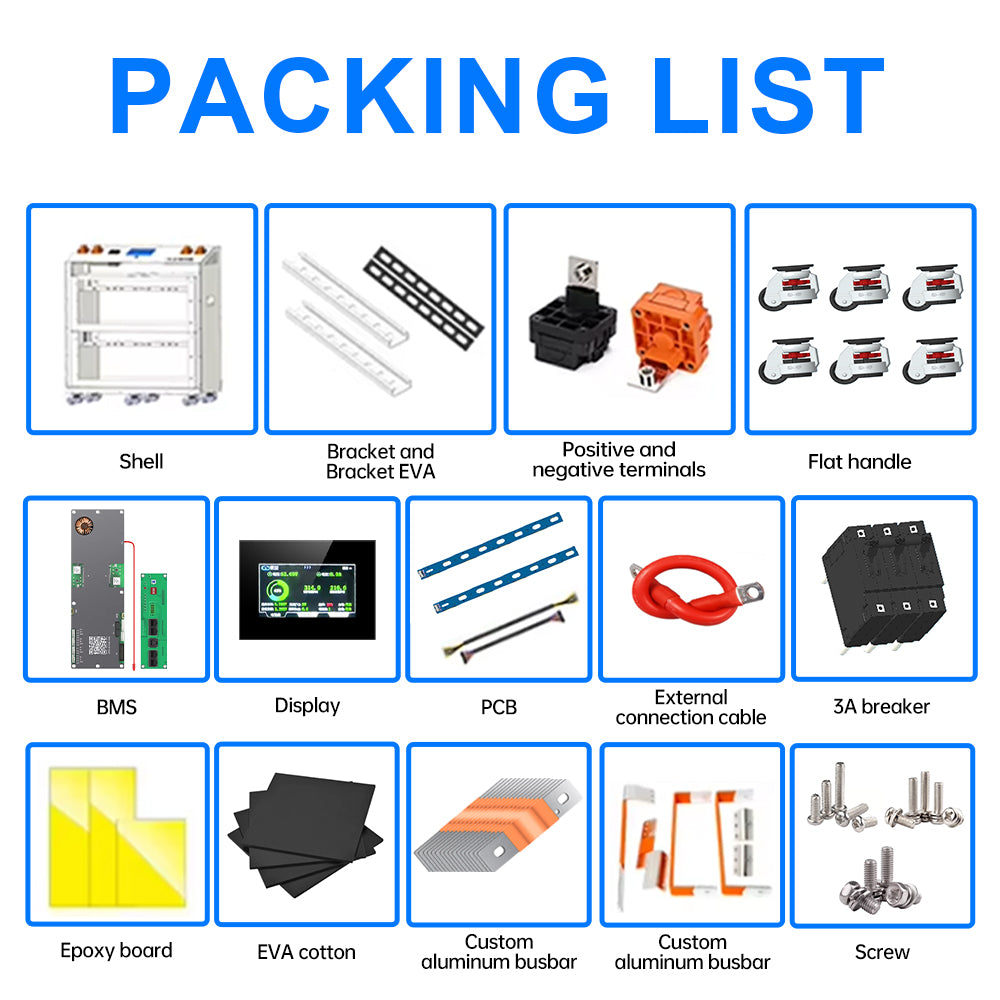
Packing List
- Steel cabinet (shell) with 6 casters and handles
- Cell brackets and EVA pads, epoxy boards, EVA cotton
- Positive and negative terminals, external connection cable
- JK-PB2A16S-30P BMS with interface board, PCB boards and cables
- 4.3-inch touch screen display
- DC breaker
- Custom aluminum busbars (2 types) and screws
- 16 × EVE MB56 628Ah Grade A cells (“With 16pcs Grade A EVE 628Ah” option only)
Warranty & Service Commitment
Since 2010, Deligreen Power has been delivering reliable energy solutions. We stand behind this kit with the following commitments:
- 10-year warranty against quality defects from the date of purchase. If a defect is confirmed, we replace the product or issue a refund.
- Lifetime technical support (installation, configuration and software troubleshooting, plus remote diagnostics).
- 12/7 professional support: engineers and customer service available 12 hours a day, 7 days a week, with a reply within 2 hours for urgent cases.
How to claim: email sales15@deligreenpower.com or WhatsApp +86 151 1640 9506 with your invoice and a short description of the issue.