

Why Your Measured Value May Differ from the Datasheet
When purchasing LiFePO4 battery cells, some customers carefully compare the internal resistance measured after receiving the cells with the Initial Internal Resistance specified in the manufacturer's datasheet.
For example, if a datasheet lists an initial internal resistance of ≤0.15 mΩ, it may seem reasonable to expect every delivered cell to measure below 0.15 mΩ.
However, this is not necessarily a technically correct comparison.
The Initial Internal Resistance stated in a manufacturer's datasheet and the internal resistance measured on a cell after capacity testing, aging, storage, transportation, and terminal processing are not necessarily measured under the same conditions.
Understanding this distinction is important when evaluating the quality and consistency of LiFePO4 battery cells.
What Does "Initial Internal Resistance" Mean?
The term Initial Internal Resistance generally refers to the internal resistance of a new battery cell measured according to specific test conditions defined by the cell manufacturer.
These conditions may include:
- A specified State of Charge (SOC)
- A controlled cell temperature
- A defined resting period
- A specific test frequency
- A specified AC or DC measurement method
- Manufacturer-defined test equipment
- Controlled terminal and contact conditions
- A cell in a defined initial condition
Therefore, the value shown in the datasheet should be understood as a technical specification measured under defined conditions, rather than a resistance value that the cell must permanently maintain throughout subsequent processing, storage, transportation, and use.
This distinction is particularly important for large-format LiFePO4 prismatic cells.
Why Can Internal Resistance Change Before the Cell Reaches the Customer?
Battery cells delivered to customers are usually not taken directly from the production line and shipped immediately.
Before delivery, cells may undergo several additional processes.
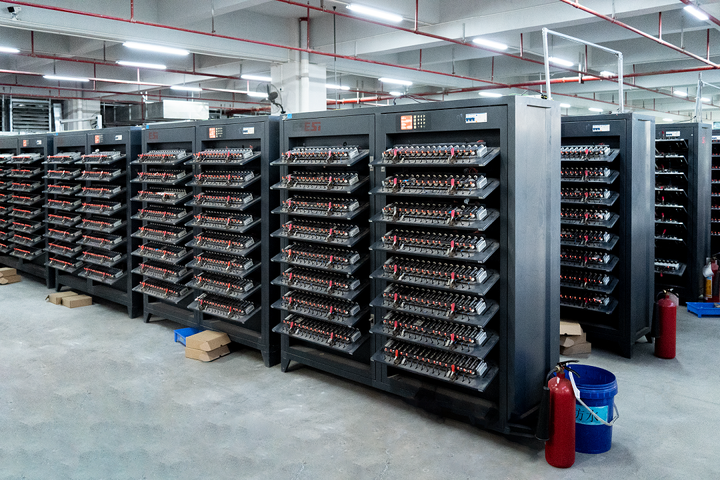
1. Capacity Testing and Grading
High-quality LiFePO4 cells are commonly subjected to charge and discharge testing to verify their actual capacity.
The cells may then be graded and matched according to parameters such as:
- Capacity
- Voltage
- Internal resistance
- Self-discharge behavior
- Overall consistency
These processes mean that the condition of the cell at the time it reaches the customer is different from its condition during the manufacturer's initial factory measurement.
2. Aging and Quality Inspection
Cells may also undergo an aging or resting period.
This allows suppliers or manufacturers to identify abnormal self-discharge, voltage deviation, or other potential quality issues before the cells are delivered.
Aging is therefore an important part of battery quality control.
However, the cell's electrochemical condition, SOC, temperature, and resting time at this stage may differ from the conditions used for the original datasheet measurement.
3. Storage Time
LiFePO4 cells may remain in storage for a certain period before final delivery.
During this time, factors such as:
- Storage temperature
- Storage SOC
- Resting time
- Time since the last charge/discharge cycle
can influence the measured electrical characteristics of the cell.
This does not automatically indicate degradation or poor cell quality.
4. Terminal Processing
Some large prismatic LiFePO4 cells are supplied with additional terminal processing, such as laser-welded studs or other connection structures.
Once the terminals have been processed, the customer's measuring instrument is no longer necessarily measuring under exactly the same physical contact conditions as the cell manufacturer's original production-line test.
Contact resistance introduced by the measurement setup can therefore influence the displayed result.
Internal Resistance Is Not a Fixed Number
One of the most important concepts to understand is that battery internal resistance is not an absolutely fixed physical value.
The measured result can change depending on the test conditions.
State of Charge (SOC)
The internal resistance of a LiFePO4 cell can vary at different SOC levels.
A cell measured at 20% SOC and the same cell measured at 50% or 100% SOC may not produce exactly the same result.
Therefore, two internal resistance measurements should only be directly compared when the SOC conditions are sufficiently similar.
Temperature
Temperature also affects battery impedance.
A cell measured in a cold warehouse may produce a different result from the same cell measured under controlled room-temperature conditions.
This becomes particularly important when cells have recently arrived after international transportation or have been stored in a cold environment.
For meaningful comparison, the cells should first be allowed to stabilize at an appropriate and consistent temperature.
Measurement Method
Different internal resistance meters do not necessarily use the same measurement method.
Depending on the equipment, the measurement may involve different:
- AC frequencies
- Test currents
- Sampling algorithms
- Measurement durations
- Calibration methods
As a result, two different instruments can produce different resistance readings for the same cell.
Contact Resistance
When measuring extremely low resistance values in the milliohm range, the quality of the electrical contact becomes very important.
Factors such as:
- Probe position
- Terminal surface condition
- Contact pressure
- Welded studs
- Busbars
- Bolts
- Oxidation
- Cable resistance
- Measurement technique
can affect the displayed result.
When discussing differences of only fractions of a milliohm, these factors cannot simply be ignored.
ACIR and DCIR Are Not the Same
Another common source of confusion is comparing resistance values obtained using different measurement methods.
Two commonly discussed battery resistance measurements are AC Internal Resistance (ACIR) and DC Internal Resistance (DCIR).
They are not interchangeable.
ACIR
ACIR is typically measured by applying a small AC signal at a specified frequency.
Many battery manufacturers use AC-based impedance measurements for production-line screening because they are fast and highly suitable for checking cell consistency.
DCIR
DCIR is normally calculated from the voltage response of a cell when a DC current load or pulse is applied.
A simplified expression is:
DCIR = ΔV / ΔI
Because ACIR and DCIR use fundamentally different test methods, the numerical results can differ substantially.
Therefore, a customer should not compare a DCIR measurement directly with a manufacturer's ACIR specification and conclude that the cell is defective.
The measurement method must first be confirmed.
Does Higher Measured Internal Resistance Mean the Cell Is Bad?
Not necessarily.
Internal resistance is an important battery parameter, but one resistance measurement alone is not sufficient to determine the overall quality of a LiFePO4 cell.
For large-format energy-storage cells, several parameters should be considered together.
Actual Capacity
Capacity testing is one of the most useful indicators of cell condition.
If a cell reaches or exceeds its rated capacity under appropriate testing conditions, this provides important information about its actual electrochemical performance.
Cell-to-Cell Consistency
For a battery pack, consistency can be just as important as the absolute resistance value.
For example, a group of 16 cells with closely matched:
- Capacity
- Voltage
- Internal resistance
- Self-discharge behavior
will generally be much easier for a BMS to manage than a group with significant differences between individual cells.
Therefore, when checking internal resistance, it is useful to look at the distribution and consistency of the entire batch, rather than focusing only on whether every cell matches one datasheet number.
Voltage Behavior
Cell voltage behavior during charging, resting, and discharging can provide additional information about cell condition.
Abnormal voltage rise, excessive voltage sag, or significant deviation from other cells may deserve further investigation.
Self-Discharge
A good cell should also maintain stable voltage during an appropriate resting period.
Abnormally high self-discharge may indicate a potential cell problem even when its initial capacity appears normal.
Why Comparing a Delivered Cell Directly with the Datasheet Can Be Misleading
Consider the following example.
A manufacturer specifies:
Initial Internal Resistance: ≤0.15 mΩ
The customer receives the cells several months later after the cells have undergone:
Production → Capacity Testing → Grading → Aging → Terminal Processing → Storage → International Transportation → Final Delivery
The customer then measures the cells using a different resistance meter, at a different SOC, at a different temperature, and through processed terminals.
Even though both results are described as "internal resistance," the test conditions are not equivalent.
Therefore, directly comparing the two numbers without considering the measurement conditions can lead to an incorrect conclusion.
A technically meaningful comparison requires the measurement method and conditions to be as close as possible to those specified by the manufacturer.
How Should You Test LiFePO4 Cell Internal Resistance?
If you want to compare the internal resistance of multiple cells, consistency in the testing procedure is essential.
A practical testing procedure should include:
- Allow all cells to stabilize at the same room temperature.
- Keep all cells at a similar SOC.
- Allow the cells to rest for a consistent period before measurement.
- Use the same calibrated internal resistance meter.
- Use the same measurement mode and frequency.
- Measure at the same terminal positions.
- Maintain consistent probe pressure and contact conditions.
- Repeat the measurement if an abnormal value appears.
- Compare the consistency of the entire group.
- Evaluate the results together with capacity and voltage performance.
If you want to compare your measurement directly with a manufacturer's datasheet, you should first identify the exact test conditions used for the datasheet specification.
Without matching those conditions, the two resistance values may not be directly comparable.
What Matters Most When Selecting LiFePO4 Cells?
Internal resistance is important, but it should never be evaluated in isolation.
For DIY battery systems and energy-storage battery packs, we recommend evaluating cells based on a combination of:
Capacity + Internal Resistance + Voltage + Self-Discharge + Cell Consistency
For example, when building a 16S 51.2V LiFePO4 battery pack, closely matched cells can help improve:
- SOC consistency
- BMS balancing performance
- Charging stability
- Discharge performance
- Usable battery capacity
- Long-term pack reliability
This is why professional battery cell grading involves more than simply checking whether a resistance meter displays a particular number.
Frequently Asked Questions
Should every new LiFePO4 cell measure below the datasheet's Initial Internal Resistance limit?
Not necessarily. The datasheet value is based on defined manufacturer test conditions. A cell measured later after testing, aging, storage, transportation, or terminal processing may be tested under significantly different conditions.
Does welded-stud terminal processing affect resistance measurements?
It can affect the measured result, particularly because the measurement path and contact conditions may differ from the manufacturer's original test setup. The quality and consistency of the terminal processing should therefore also be considered.
Can I compare internal resistance measurements from two different testers?
You can use them as a reference, but the results may not be directly comparable. For cell matching, it is better to use the same calibrated tester, measurement method, temperature, SOC, and contact method for every cell.
Is internal resistance more important than capacity?
Both are important, but they describe different aspects of cell performance. A proper cell evaluation should consider capacity, resistance, voltage behavior, self-discharge, and cell-to-cell consistency together.
Why do 16 cells have slightly different internal resistance values?
Small variations are normal. The more important question is whether the cells show reasonable consistency when tested under identical conditions. A single value should not be evaluated without considering the overall distribution of the pack.
Conclusion
The Initial Internal Resistance listed in a LiFePO4 cell datasheet should not be interpreted as a permanent resistance value that every delivered cell must reproduce regardless of when, where, and how it is measured.
A battery cell may undergo capacity testing, grading, aging, terminal processing, storage, and transportation before reaching the customer.
At the same time, internal resistance measurements are affected by factors including:
SOC, temperature, resting time, measurement method, test frequency, equipment calibration, terminal condition, and contact resistance.
Therefore, evaluating a LiFePO4 cell simply by comparing a customer's resistance-meter reading with the manufacturer's Initial Internal Resistance specification can be misleading.
A more technically meaningful evaluation considers the test method, test conditions, actual capacity, voltage behavior, self-discharge, and consistency among cells together.
For battery builders, the objective should not be to chase a single resistance number—it should be to select healthy, high-capacity, well-matched cells that perform consistently as a complete battery system.
